
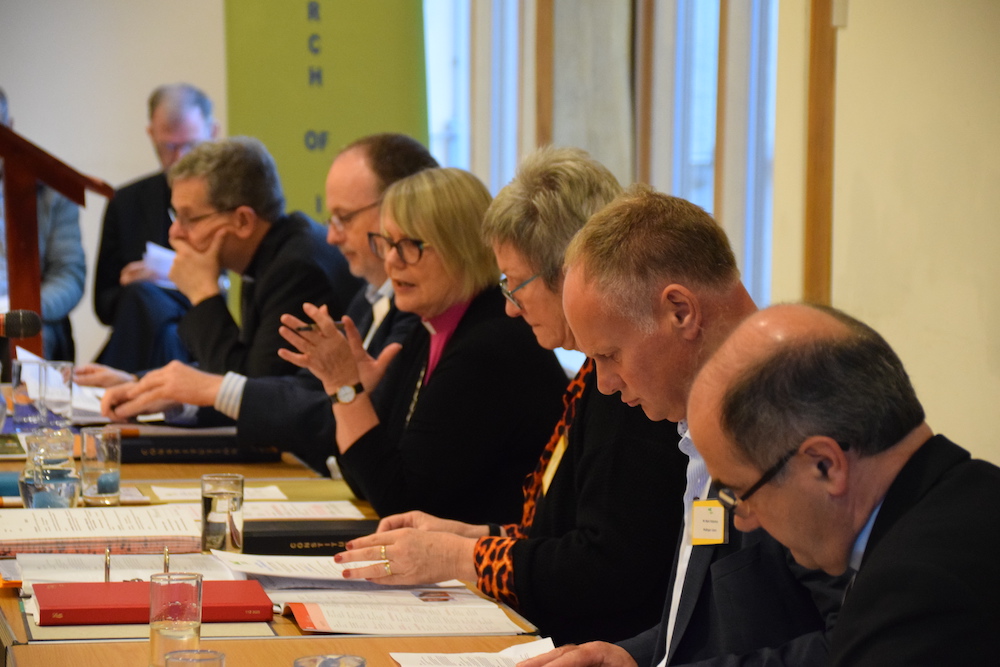
The 2023 Diocesan Synod for Meath and Kildare was held in the Oak Centre, Dunboyne on Saturday 30 September. It was chaired by Bishop Pat Storey.
Presidential Address
In her opening remarks Bishop Storey thanked everyone for taking the time to represent their parishes, saying: “Whilst it is our equivalent of an AGM, we are not here just to do business – first and foremost we are a community of faith. We have business to do – and we have to look after our properties and our finances, but the reason that we do that is primarily because we are followers of Jesus Christ, and we are in God’s hands as we go.”
She talked of the need to create “the best conditions in which growth can happen”, alluding to the presence of Rev Rob Jones and Canon Barry Forde at the synod, who were there to talk about the “about the new emphasis and impetus of Pioneer Ministry on the whole Church of Ireland. “
Continuing, she said: “Pioneer ministry is one strand of ministry – best worked out alongside traditional ministry and with the enthusiastic support of the local clergy. Pioneer ministry is about trying new things. It is a risk, and its emphasis is on those who aren’t sitting in the pews, rather than those who already are. The pioneer seeks to welcome, awaken and integrate the newcomer and the person who perhaps does not yet have faith, and in order to do that, we have to try different avenues.”
Bishop Pat highlighted one of the pioneer initiatives taking place in the diocese, with St Brigid’s Cathedral in Kildare celebrating the 1500th anniversary of St Brigid – opening up the cathedral and welcoming visitors, seekers, and spiritual pilgrims. She also said, “If you or your parish would be interested in a similar new initiative, there is money, training and resources available through Pioneer Ministry.”
A number of new members of the diocese were welcomed, including: Dean Isobel Jackson and Kelley Bermingham (Kildare and Newbridge), as well as Craig McCauley (Naas), and Mike Buchanan joining John Clarke in Navan. Good wishes were also expressed to Eugene and Joanna Griffin who have moved from Dunboyne and Rathmolyon to Kinsale.
Talking of the financial challenges over the last few years and particularly during and after the pandemic, Bishop Pat expressed a “sincere thank you to all of you who have worked hard and given generously to your parishes … It is thanks to our churchgoing people, who love their church and their Saviour, who are making going forward with hope possible.”
Turning to education Bishop Pat expressed appreciation for Frank Milling, in his first year as principal of Wilson’s Hospital school, and to all the principals and teachers of national schools across the dioceses who do wonderful work with our children.
She also thanked all the clergy, Karen Seaman (Diocesan Secretary) and archdeacon Leslie Stevenson for all they do for the dioceses, and to ever person present for all they do to “make the dioceses work”. Appreciation was also expressed for the particular contributions of a wide range of people within the dioceses, including members of the synod itself.
To read the full text of the Bishop’s speech, click on the link below:
Thanks to all our stallholders for their presence at the Synod.
Reports
The report of the Diocesan Council was presented to synod and proposed by Mr Mark Potterton and seconded by Rev William Seale. Both emphasised the need for good governance. They acknowledged the additional work involved in various areas of compliance, whilst also recognising its importance. These emphases were also reflected in some of the speeches from the floor, that followed.
The report of the Diocesan Board of Education was presented by Archdeacon Leslie Stevenson and seconded by Mr Des Kenny. Admiration was expressed for the many creative artistic contributions by all schools across the dioceses for the annual Bishop’s Medal competition. Congratulations was expressed to the pupils of Monasterevin National School, winners of the Bishop’s Medal this year.
Recognition of the increasing complexities in managing schools was noted, as well as appreciation for the great service of so many who serve in various roles, often voluntarily, to manage schools. Reference was also made to the significant financial challenges and regulatory obligations of managing the running of schools, with the question of whether there was a structural issue, particularly in regard to government funding models.
Synod members agreed to suspension of Standing Orders, to allow for presentations on behalf of the The Church of Ireland Marriage Council as well as the MindMatters Committee, by Bishop Pat Storey. It also allowed for presentations about one of the most recent initiatives by the Church of Ireland – Pioneer Ministry.
A video produced by the Church of Ireland Marriage Council was shown to the synod. It highlighted the work of the Marriage Council.
Pioneer Ministry – A Vision ‘to reach out to those with little or no connection with Church‘
Rev Rob Jones (National Director) and archdeacon Barry Forde (Operational) – both responsible for the Church of Ireland Pioneer Ministry initiative – spoke about what the hopes and shape of pioneer ministry might look like.
The Representative Church Body of the Church of Ireland is funding this new initiative – one of the largest funded projects within the Church of Ireland.
Statistics show that half a million people in Ireland now say they have no religion, with young people being the highest group within this. However the Church of Ireland has been working on a constructive response to this new emerging context.
Pioneer ministry has its essence in the very name. A pioneer does new things and goes to new placed. Rob mentioned that one example of a great pioneer was Ernest Shackleton, the well known explorer. It was emphasised that it is not devaluing of or a threat to traditional ministry.
The ambition is for new initiatives that are sustainable and are in the context of local dioceses and parishes.
- The initiative is building on all the great work that has gone before.
- One of the striking things in the presentations was a willingness to face realities of a changing religious context, with analysis and thinking based on solid evidence.
- The challenge is how to do the church that we know and love, and do it well, and also how to reach those people who now have no connection with church.
- The Church in all of its history has lived in seasons of challenge and change.
- The House of Bishops, the Representative Church Body and General Synod have all put their weight behind this new initiative.
Vision – to reach out to those with little or no connection with Church.
To find out more about this great new initiative list www.pioneerministry.org of email info@pioneerministry.org
Kelley Bermingham, from Kildare Centre of Mission, was then invited to speak about what pioneer ministry looked like in their context. She made the point that St Brigid’s Cathedral was dedicated to one of the great pioneers of faith in her time. She also reflected on the willingness
What is a Diocesan Synod?
Every Church of Ireland diocesan synod consists of the bishop, the beneficed and licensed clergy of the diocese, and elected lay members from parishes from across the dioceses. This synod meets under the presidency of the Bishop, and has responsibility for many aspects of diocesan life. For instance, it elects the diocesan council (comprising lay and clerical members) which is in a sense the executive committee of the diocesan synod. Every third year the diocesan synod elects the clergy and laity who will represent the diocese on the General Synod.[1]
[1] https://www.ireland.anglican.org/our-faith/church-teaching/clergy-and-people