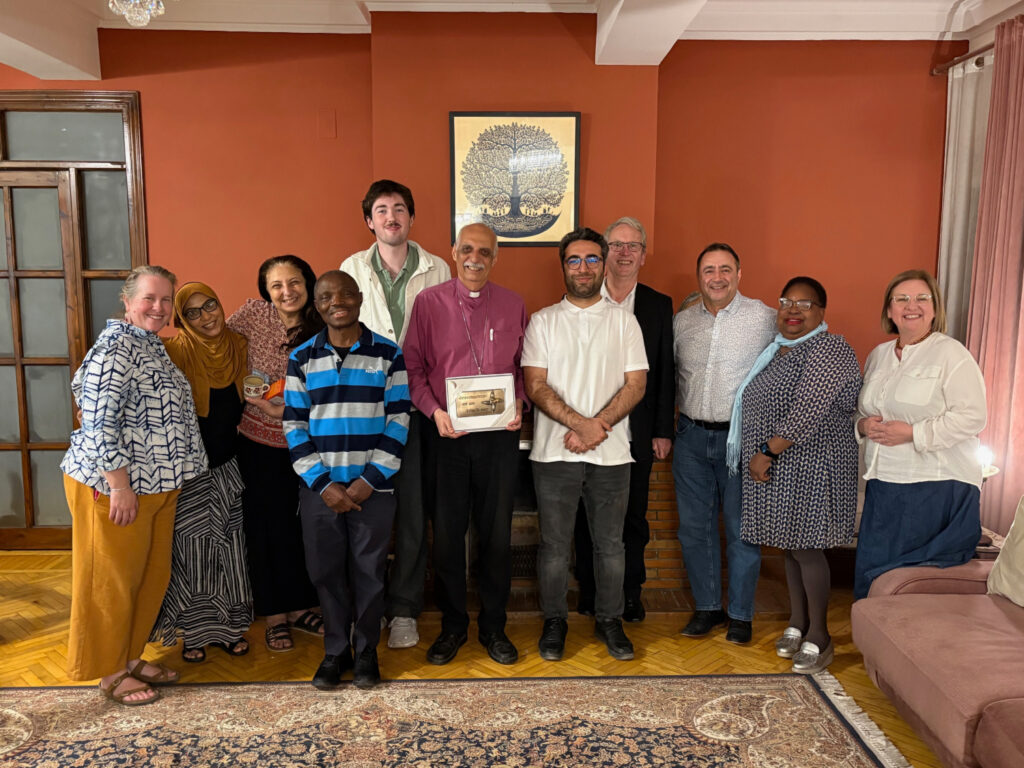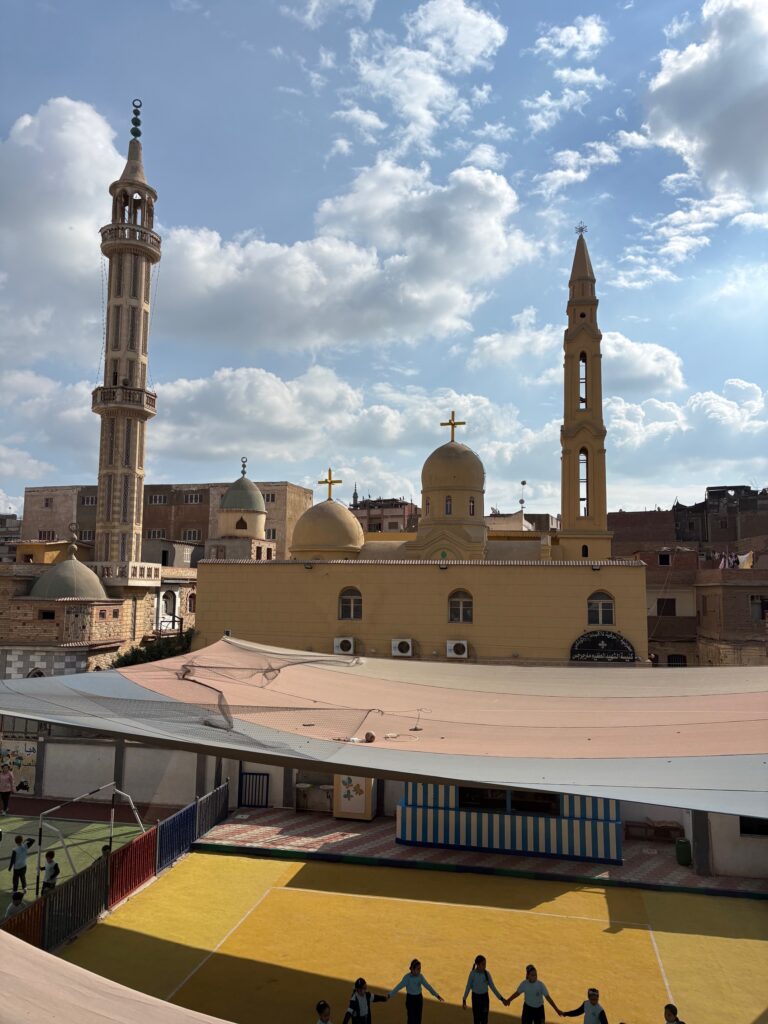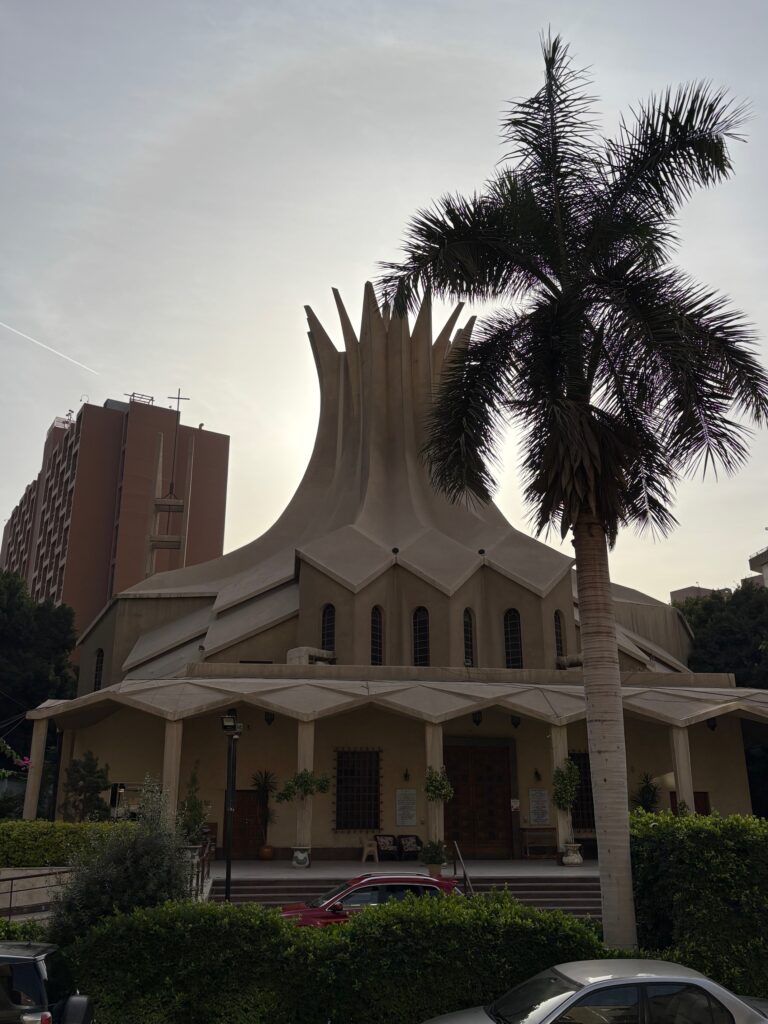
Last week Dean Abigail Sines was out of the country participating and co-leading an interfaith Pilgrimage to Cairo, Egypt. The programme was a collaboration between the Church of Ireland Interfaith Working Group and the Church Mission Society Ireland (CMSI), working closely with the Anglican Province of Alexandria. The Programme has focused on the work of the Diocese’s Centre for Christian-Muslim Understanding and Partnership (CCMUP), which was founded in 2022. The Centre, whose mission is combating extremism, and promoting peace, understanding and cooperation between people of different beliefs and backgrounds in Egypt and beyond, works closely with Al-Azhar Al-Sharif, Egypt’s oldest institution of Islamic scholarship, dating back to 970 AD.
Here Dean Abigail shares some reflections on her time in Egypt.
Reflection by Dean Abigail Sines
We were a group 10 travelling together, drawn from right across the island of Ireland and we travel as an interfaith group of 8 Christians and 2 Muslims. The programme was planned this way from the outset. We weren’t just there to learn about what happens in Egypt – our group included different faiths which meant we would be listening to and learning from one another throughout our travels. We also planned that we would have ‘team time’ each evening, with shared silence, as well as reflection on the day to help as to process all that we would be experiencing.
Our first day properly on-the-ground was Sunday, 1 November. As it happens we are staying in the diocesan compound and the diocesan cathedral is called All Saints’, so it made our attendance on All Saints’ Day feel quite special! In the afternoon we had a whirlwind tour of the Grand Egyptian Museum and the pyramids, and were warmly welcomed by Archbishop Samy and his wife, Madame Madeline, to their home for a feast of Egyptian food in the evening. It was wonderful start to the programme!
The real work began on day 2 when we joined in the ‘Journey of Learning’ programme organised by CCMUP. These ‘Journey’ programmes involve Christian and Muslim theologians, Egyptian university students, as well as international young adults who are working as interns in CCMUP. For the discussions, we jumped right into the deep end! Dr. Amr Abdel-Hamid Ragheb El-Shaal spoke about the concept of Divine Unity in Islam, while Dr. Shady Anis presented on the understanding of Unity and Trinity from the Christian perspective. While I have studied trinitarian theology during my own theological studies, I found it fascinating to hear a Muslim perspective on the importance of Unity or One-ness, and to learn of the logical line of argumentation that is applied to this. The afternoon session was equally rich, addressing the topics of forgiveness and mercy, with presentations from Dr. Ismail Abdullah from Al-Azhar University and Bishop Mouneer Hanna, Archbishop Emeritus of Alexandria and the Director of CCMUP. Dr Ismail’s began his presentation highlighting that mercy is the fundamental characteristic of God, and the quality that is most associated with God’s name, who is called ‘Most Merciful’. Bishop Mouneer in his presentation used the parable of the Prodigal Son to give a picture of God’s mercy, and highlighted the evidence of a changed life as our response to God’s mercy. For this he used the example of Zaccheus making amends for cheating people of money in the past. He wasn’t purchasing forgiveness, his joyful response was the evidence that because of the mercy received he was choosing to live a different way.
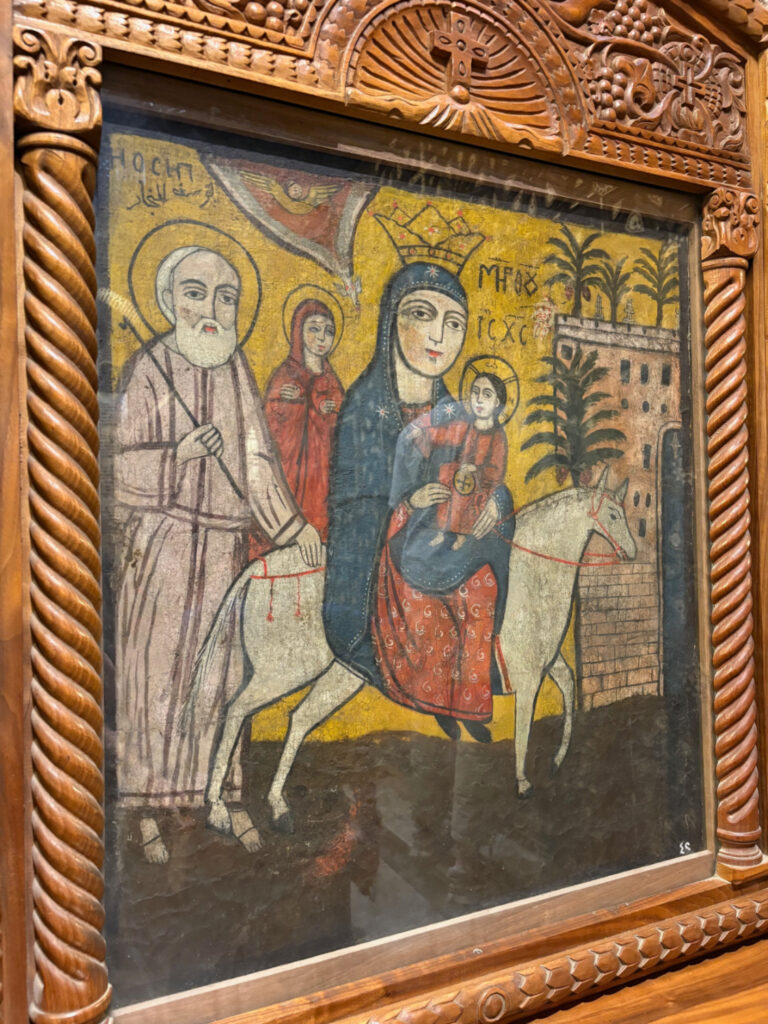
Day 2 of the ‘Journey of Learning’ involved a morning session of scriptural reasoning, an interfaith practice of reading and reflecting on texts from different faith traditions. The session focused on the character of Noah as he appears in the Quran and in the New Testament (when ‘the days of Noah’ are referred to)—which opened up a very interesting discussion! As people from both faiths reflected, a lot came down to patience and persistence: patience on the part of God who delayed destruction by the flood, and persistence by Noah, who remained faithful even in the face of opposition and mocking by those around him. After the morning’s discussion it was time to see more of this historic city. One thing to know: the visit of the Holy Family to Egypt, seeking safety from Herod’s threats on the infant Jesus’ life is a hugely, spiritually significant event in Egypt! There are many historic churches located on sites that were reputed to have been the places where the Holy Family stayed for some time during their stay in Egypt. One is built over a cavern residence, reputedly where the Holy Family lived for 3 months during their stay in Cairo. This was also our opportunity to visit Ben Ezra Synagogue, formerly a Coptic Church that was later sold to the Jewish community, and reputedly built on the site where Moses was drawn from the water after being left among the bulrushes! After the various churches and synagogue it was on to the Amr ibn al-As Mosque, the oldest mosque in Egypt, established in 642AD.
Wednesday brought a day of contrasts, some of the group described it as a day touching on three different worlds. In the morning we visited the San Raphael Development Centre which is one of the caring ministries of the Diocese. The Centre houses a school that serves just over 200 Sudanese refugee children from both Christian and Muslim backgrounds. We were moved by the dedication of the principal in challenging circumstances and the intentionality of looking after the children’s and teachers’ emotional and psychological well-being to the best of their ability. The ground floor hosts vocational programs for local Egyptian women and educational supports for local children from kindergarten to third class. There is plenty of need and the Diocese is committed to continuing to develop the facility as resources allow. From there we travelled to Al-Azhar Al-Sharif University; to visit the Al-Azhar Observatory for Combating Extremism. This is a specialised research and advocacy centre that monitors extremist media and communication sources in 13 languages. The goal of their work is to counter extremist rhetoric and promote moderate interpretation of Islamic texts. We then met with the Grand Mufti of Egypt, Dr. Nazir Mohammed Ayyad, who has been an active advocate for interfaith dialogue for many years. No rest for the weary, we were graciously hosted for an evening reception in the home of the Irish Ambassador, after which we were well and truly ready for a good sleep.
We had the opportunity to visit another important Coptic institution: St Macarius Monastery, which is in the desert some distance away from Cairo. Brother Barnabas, who has been in the monastery for 13 years, was the monk who showed us around and he was truly a delightful soul. He radiated a sense of joy, calm and welcome, and we all felt incredibly privileged just to have some time to experience the place. He went to university, completed his degree and worked for a few years outside, but he always felt the calling to devote himself to the monastic life, and he is clearly living out his calling with delight. During our ‘team time’ several shared how peaceful the place seemed, in contrast to the noise and slightly chaotic driving of the city. One even commented it made her feel like she could leave everything behind and just stay there in that peaceful state!
But we had yet another Coptic church to experience: the Cave Church carved into the limestone cliffs of Mokattam hill. The neighbourhood is called Zabaleen and is referred to as ‘Garbage City’ as it is the site for waste sorting and recycling. We may have an image of what a recycling centre is in Ireland, but this is a whole different world. Bags of rubbish are opened and sorted by hand, and materials with value are gathered and bundled together. Our skilful bus driver navigated the narrow unpaved streets. Most residents of Zabaleen are Coptic and although a poor area of the city it is still full of life, people coming and going, shops selling essential goods, fresh bread being on offer from small bakeries, and every type of transport imaginable from donkey carts, to motorcycle taxis, to lorries somehow managing to make their way through. Eventually we arrived at the Cave Church complex, we could hardly have known what to expect! We were there on a Friday afternoon, and Friday being the day off in the week here, it was full of people with children running around and enjoying the space and fresh air above the closely knotted streets and tall buildings of the garbage sorting area. There was even a zip line installed and a high ropes course! Seeing the crowded conditions of the neighbourhood, it made perfect sense: getting in and out of the area is certainly not convenient, so the upper areas of the cliffside are the best option. The complex as it currently is dates back to the 1970s, and includes medical care, development, youth and entertainment facilities. The main church seats 20,000 making it the largest Coptic Church in Egypt or the Middle East. Its name sake is St Simon the Tanner hearkening back to a 10th century legend. The Coptic Patriarch at the time was challenged by the ruling caliph to demonstrate his faith by praying to God to cause a certain mountain to move location. The patriarch was shown in a vision that it was not he whose faith was great enough, but Simon the Tanner, a simple man who repaired shoes and provided water for the poor. It’s easy to see why the character of Simon the Tanner would resonate with the community of Zabaleen.
It is sad to think of this experience ending! During our evening ‘team times’ we have each expressed how grateful we are for the experience: to learn from the interfaith work of the church here, to have time with each other to ask questions and to learn more about each others’ faith. For myself after just the first day, my reaction was ‘I wish everyone could experience this.’ I know that reads as an exceedingly simplistic sentiment. But there is just so much in this experience, it’s impossible to describe, it needs to be experienced: to be welcomed, to see Christians and Muslims dialoguing together constructively and respectfully, to see the faith that is required to take a step that is risky. Dialoguing with those who are different can bring criticism from one’s own community, and of course there is always the possibility that the dialogue will get off track and turn into an argument. From the outset in planning for this interfaith pilgrimage it was always possible that personalities might not work well together, that it would turn out to be a detrimental rather than inspiring experience. But every step of faith involves risk. It has been my privilege to be part of getting ready for this programme over the last year and now to experience it is humbling and an absolute joy. But I am also conscious that many have laid the groundwork, people such as Bishop Mouneer who has been engaging in interfaith work for decades now. We each of us, in all different types of ministry, seek to faithfully build and strengthen what has gone before. Our hope is that as we have been blessed, that we have been an encouragement and blessing to our hosts here in the Dioc