The Anglican Consultative Council met in Belfast from 28 June to 4 July 2026, bringing together Anglicans from across the world to pray, learn, discuss and share fellowship. For the Church of Ireland, it was both a privilege and a responsibility to welcome the wider Communion. The smooth running of the week was a testament to the dedication of the Church of Ireland team, the Anglican Communion Office, and many others working quietly behind the scenes.
The opening service was a Choral Eucharist in St Anne’s Cathedral. Canon Maggie Swinson preached, the Archbishop of Armagh celebrated, and the music, including uilleann pipes and a Psalm from Celtic Psalms, gave the service a distinctly local and prayerful character. From the beginning, readings and prayers from across the Communion reminded us that this was a gathering of many voices, cultures and contexts.
The Presbyterian Assembly Buildings provided an excellent venue. Plenary sessions, worship and meals were all held close together, and the lobby quickly became a lively place of conversation, friendship and learning.
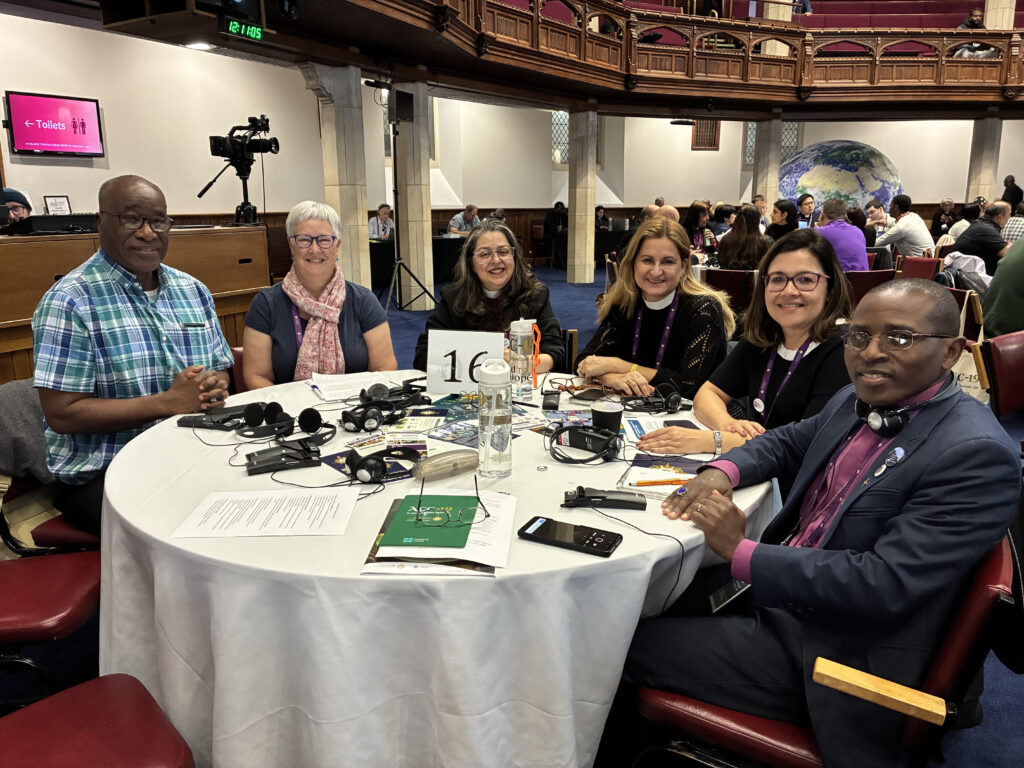
One of the great strengths of the week was the seating around round tables, with representatives from different provinces. At my table were members from Brazil, Mozambique and Angola, Central Africa, the United States, the Old Catholic Church, and the International Anglican Women’s Network. Conversation was never abstract; it was rooted in real lives, real churches and real experience.
Each day began with Morning Prayer, followed by Bible Study on Acts 15:1–16:5 under the theme “Called to One Hope”. Together we considered the early Church’s struggles with difference, discernment and unity, and how closely those questions still speak to the Church today. The studies helped build trust because everyone had space to contribute and to listen.
The morning sessions also included “Listening Across Churches”. These conversations invited us to speak honestly about our contexts: the signs of hope we see, the challenges we face, and the resources that might help us in mission and ministry. I was struck again and again by the diversity of the Communion and by the faithfulness of churches serving in circumstances very different from our own.
One major item before the Council was the IASCUFO document known as the Nairobi-Cairo Proposals. Many of us had spent time studying it before Belfast, and members of IASCUFO reported on the extensive work carried out since 2023.
Discussion made clear that the proposals would not be easily or quickly acted upon. Conversations were respectful and honest, but there was concern as well as thought. In the end, the Council’s response was cautious, calling for more time, for relationships and trust to grow, and for further discernment about leadership within the Anglican Communion.
Worship shaped the rhythm of each day. Morning sessions concluded with the Eucharist, with celebrants from across the Communion using the liturgy in their own languages. Evening Prayer brought the formal proceedings to a close, and Night Prayer was offered for those still gathered.
Lunchtime and afternoon sessions gave us opportunities for Global Conversations on evangelism, discipleship, the environment, refugees and migrants, education, safeguarding and inter-faith matters. It was humbling to hear about the situations in which so many live and minister, often facing challenges we can barely imagine.
We also heard from the Networks and Commissions of the Anglican Communion, whose work reminded us that our local life is connected to the mission and support of churches across the world. The Safe Church Commission was especially significant, reminding us that safeguarding is not simply a policy matter, but an expression of the gospel and of the Church’s integrity.
The Commission for Evangelism and Discipleship brought forward “Vision 36”, a proposal to plant or reinvigorate a million churches around the Communion in the next decade. It is an ambitious vision, and discussion showed both the hope and the difficulty of mission in very different contexts.
There were also many opportunities for fellowship beyond the formal sessions, including workshops, a walking tour of Belfast, Sung Compline in St George’s Church, and visits connected with C.S. Lewis.
In the middle of the week, we made a pilgrimage to Derry/Londonderry. Despite poor weather, the welcome from the Diocese of Derry and Raphoe and from the city was generous. A particularly powerful moment came at St Augustine’s Church, where Richard Moore told us his story of being shot as a child and later meeting the soldier who fired the bullet. It was a moving witness to forgiveness and hope. Evensong in St Columb’s Cathedral brought the visit to a beautiful close.
On the final day, the resolutions were put to the Council and agreed after discussion of amendments. The provinces will now have time to respond before the next meeting of the ACC, to be hosted by the Church of North India in 2029.
The closing Eucharist in St Anne’s Cathedral was a fitting act of thanksgiving. The Archbishop of Canterbury preached, the Bishop in Jerusalem celebrated, and people from across the Communion took part. The music gave the service a strong sense of celebration and hope.
To have been a participant once again was an amazing experience. It is difficult to put into words what it means to meet people for the first time, renew friendships made in the past, and see more clearly the links that hold us together. The Anglican Communion is not simple, and it is not without tension, but ACC 19 reminded me that it is also full of faithfulness, courage, prayer and hope.
The small Church of Ireland team and the Anglican Communion Office worked very hard to put this conference together and to have been involved in this was also a great experience. The week was busy for the volunteers who were in Belfast with many logistical conundrums to resolve. I am deeply grateful for having been involved in every aspect of ACC 19.
Words and photos by The Venerable Katharine Poulton, Archdeacon of Meath and Kildare